7 Japanese Phrases for Your First Day at a Japanese Company
Team KakehashiX
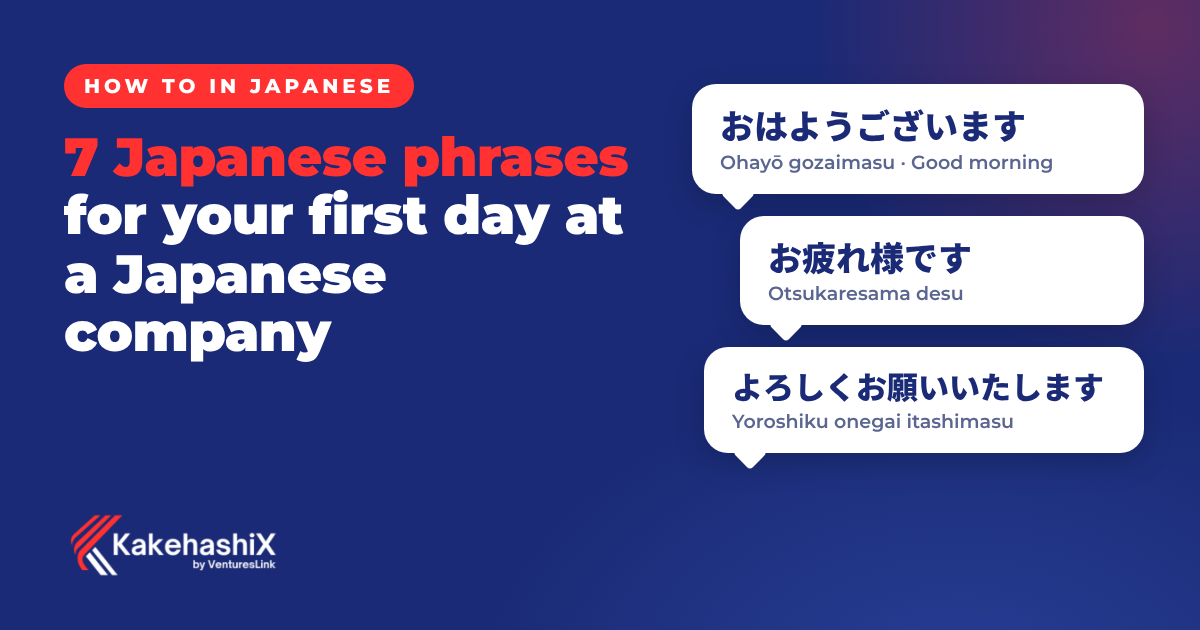
Your first day at a Japanese company is about more than the work itself. How you greet people, introduce yourself and respond to instructions leaves a strong first impression. The good news is that a handful of phrases cover most of the situations you’ll meet on day one.
Here are seven to learn before you start.
1. Introducing yourself
本日からお世話になります。(Your name) と申します。よろしくお願いいたします。
Honjitsu kara osewa ni narimasu. (Your name) to mōshimasu. Yoroshiku onegai itashimasu.
“Starting today, I’ll be working with you. My name is (your name). I look forward to working with you.”
Tip: to mōshimasu is a humble way of saying “my name is”, and it’s more polite than desu. Finish with a small bow.
2. Greeting everyone when you arrive
おはようございます。
Ohayō gozaimasu.
“Good morning.”
Tip: say it clearly when you arrive, to the whole team, not only to the person next to you. A confident greeting is one of the easiest ways to make a good impression.
3. The all-purpose workplace greeting
お疲れ様です。
Otsukaresama desu.
Roughly “thank you for your hard work.”
Tip: use it when you pass a colleague in the hallway, at the start of an internal call or email, and when someone finishes their work. Avoid gokurōsama desu, which is used toward people junior to you.
4. Entering, interrupting and leaving
失礼します。 Shitsurei shimasu. “Excuse me.”
お先に失礼します。 Osaki ni shitsurei shimasu. “Excuse me for leaving before you.”
Tip: say shitsurei shimasu when you enter a meeting room or interrupt someone. When you go home before your colleagues, say osaki ni shitsurei shimasu. They’ll usually reply otsukaresama deshita.
5. Saying “understood” politely
承知しました。
Shōchi shimashita.
“Understood.”
Tip: ryōkai desu also means “understood”, but many people consider it too casual for managers and clients. Shōchi shimashita or kashikomarimashita are the safe choices.
6. Asking someone to repeat or explain again
恐れ入りますが、もう一度教えていただけますか。
Osoreirimasu ga, mō ichido oshiete itadakemasu ka.
“I’m sorry to trouble you, but could you explain that once more?”
Tip: it’s better to ask than to guess. You can also ask memo o totte mo yoroshii deshō ka (“May I take notes?”). Taking notes shows you’re serious about learning.
7. Apologising for a mistake
申し訳ございません。すぐに確認いたします。
Mōshiwake gozaimasen. Sugu ni kakunin itashimasu.
“I’m very sorry. I’ll check right away.”
Tip: for mistakes at work, mōshiwake gozaimasen is more appropriate than a quick sumimasen. Following it with what you’ll do next shows responsibility.
Quick cheat sheet
Situation | Say this |
|---|---|
Introducing yourself | Honjitsu kara osewa ni narimasu. (Name) to mōshimasu. Yoroshiku onegai itashimasu. |
Arriving at work | Ohayō gozaimasu. |
Passing a colleague | Otsukaresama desu. |
Entering a room | Shitsurei shimasu. |
Leaving before others | Osaki ni shitsurei shimasu. |
Accepting an instruction | Shōchi shimashita. |
Asking again | Osoreirimasu ga, mō ichido oshiete itadakemasu ka. |
Apologising | Mōshiwake gozaimasen. |
Your Japanese doesn’t need to be perfect
Japanese companies often value effort and willingness to learn as much as fluency. Read more in Worried your Japanese isn’t perfect? and find out which JLPT level Japanese companies actually require.
Ready for your first day? Browse Japanese-speaking jobs on KakehashiX.
About the Author
Team KakehashiX
Contributing writer at KakehashiX, sharing insights on Japan-Indonesia professional connections and career development.