Why Indonesian Talent Is in High Demand
Team KakehashiX
For most of the last decade, a Japanese company looking to hire overseas talent had one obvious answer: Vietnam. That answer is changing. Between 2024 and 2026, Indonesia moved from a secondary sourcing market to the second-largest supplier of Specified Skilled Workers in Japan — and by some measures, the single largest pipeline of Japanese-language learners preparing to work in the country.
This article breaks down why: what is pulling demand from the Japanese side, what is pushing supply from the Indonesian side, and what employers need to get right to convert that opportunity into retention.
1. Indonesia is Japan's fastest-growing talent source
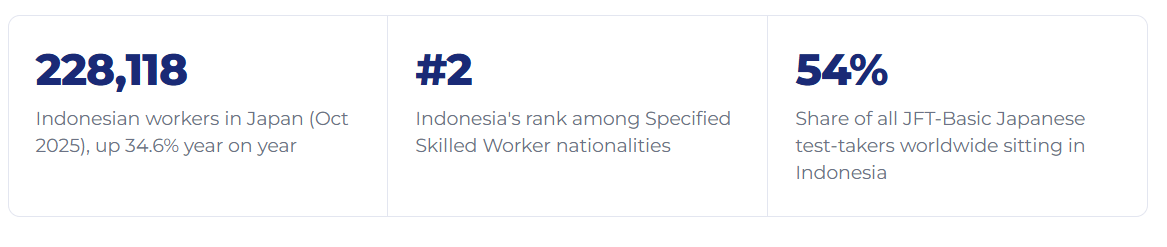
Japan's foreign workforce reached a record 2.6 million in October 2025 — the thirteenth consecutive annual high. Within that total, Indonesia posted the second-largest year-on-year growth of any nationality at 34.6%, reaching 228,118 workers. Only Myanmar grew faster.
The Specified Skilled Worker (特定技能 / SSW) channel tells the story more sharply. Indonesian SSW holders rose from roughly 44,300 in June 2024 to 69,537 in June 2025 — a 57% jump in twelve months — then added another 24.7% in the following six months. Indonesia now sits second only to Vietnam.
Vietnam still leads the SSW programme, but its share is shrinking: roughly 47% at the end of 2024, 44% by mid-2025, and 42.1% by December 2025. Japan's foreign talent supply is diversifying away from single-country dependence — and Indonesia is the primary beneficiary.
2. The demand side: a shortage measured in millions
Japanese employers are not recruiting overseas because it is fashionable. They are recruiting because the domestic maths no longer works.
An 11 million worker shortfall by 2040. The Recruit Works Institute projects Japan's working-age population will fall roughly 20% from 2020 levels to about 59.8 million by 2040, with the decline accelerating sharply from 2027.
A larger legal ceiling than ever before. In January 2026 the Cabinet reset intake targets: 805,700 places for SSW over five years, plus 426,200 under the incoming Employment for Skill Development system — about 1.23 million in total, the largest figure since the programme began.
More sectors, not fewer. Linen supply, logistics warehousing and resource circulation were added in January 2026, taking the programme to 19 designated industry sectors.
A parallel white-collar gap. METI's widely cited projection puts Japan's IT professional shortfall at up to 790,000 by 2030 — a gap no amount of domestic graduate hiring will close.
Put simply: the ceiling on foreign hiring keeps rising, and the domestic labour pool keeps falling. That gap is what employers are now competing over.
3. The supply side: why Indonesia, specifically
A demographic window that is open now
Indonesia's working-age population (15–64) stands at roughly 195 million people, about 68% of the national total, with a median age near 31. The labour force is around 155 million. Crucially, youth unemployment sits at 16.26% among 15–24 year-olds — the highest of any age band — which means a large, educated, motivated cohort is actively looking for opportunities that domestic hiring cannot yet absorb.
That is a mirror image of Japan's problem, and it is why the two markets fit together so well right now. It is also time-limited: Indonesia's own dependency ratio starts climbing from the 2040s.
The Japanese-language pipeline is already built
This is the point most employers underestimate. In the February–March 2025 sitting of the JFT-Basic Japanese language test, 17,771 of 32,642 candidates worldwide sat the exam in Indonesia — 54% of the global total. The next largest country, Nepal, accounted for 15%.
Testing runs across eight Indonesian cities — Jakarta, Surabaya, Bandung, Yogyakarta, Medan, Semarang, Denpasar and Manado — six times a year. The infrastructure to produce work-ready, Japanese-capable candidates at volume already exists on the ground.
What this means for hiring
Indonesia is not an emerging supply market that needs building. It is an established one that most Japanese employers have simply not tapped yet. The candidates are already studying, already testing, already certified.
4. Where Indonesian talent is actually landing
Across all SSW nationalities, the sector distribution as of December 2025 looked like this:
Sector | SSW workers | Share |
|---|---|---|
Food & beverage manufacturing | 95,644 | 24.5% |
Nursing care (介護) | 67,871 | — |
Industrial product manufacturing | 57,576 | — |
Construction | 51,122 | — |
Food service (外食業) | 44,925 | — |
Nursing care deserves particular attention for Indonesian hiring. Indonesia has sent care workers and nurses to Japan under the bilateral Economic Partnership Agreement since 2008, meaning there is a longer institutional track record — training providers, alumni networks, returnee trainers — than in almost any other corridor.
Important caveat for 2026
From 13 April 2026, new SSW intake in the food service sector (外食業) was suspended in principle, after the sector approached its 50,000-person cap. Transfers from workers already holding food service SSW status and certain transitional cases remain possible, but new overseas recruitment into this sector has largely closed. Employers in adjacent sectors should read this as a warning: caps are now being actively enforced, and early movers get the places.
5. Why 2026–2027 is the decision window
Three things are converging over the next eighteen months.
The Employment for Skill Development system launches April 2027. Replacing the Technical Intern Training Programme, it is designed around a three-year development period that feeds directly into SSW status. Employers who build their Indonesian sourcing relationships now will enter that system with a working pipeline rather than starting from zero.
Long-term retention is becoming real. SSW Category 2 (特定技能2号), which carries no cap on renewals and allows family accompaniment, reached 12,420 holders by March 2026 — roughly 2.6 times the previous period. Foreign staff are shifting from a three-year cost centre to a long-term workforce, which changes the return on every yen spent on onboarding.
Sector caps are filling. Food service has already closed. Food and beverage manufacturing is around 70% of its target and construction around 65%. Available places are a finite resource being consumed in real time.
6. What employers need to get right
Demand alone does not produce retention. Three things separate companies that keep Indonesian staff from those that lose them in year two.
Religious and dietary accommodation. Indonesia is Japan's largest source of workers from a Muslim-majority country. Halal-compatible canteen options, a quiet room usable for prayer, and flexibility during Ramadan are not perks — they are the baseline that determines whether someone stays. They are also inexpensive relative to the cost of replacing a trained worker.
Japanese language support that continues after arrival. JFT-Basic certifies A2-level ability. That is enough to start work; it is not enough to grow into a supervisory role. Companies that fund continued study see faster progression into SSW Category 2 — and those workers stay.
A visible career path. The single strongest retention lever is a stated route from Category 1 to Category 2, with the criteria written down. Workers who can see a five-year future stop treating the role as temporary.
Hiring Indonesian talent with KakehashiX
KakehashiX connects Japanese employers with Japanese-speaking Indonesian professionals — from Specified Skilled Worker candidates through to bilingual engineers and graduates. We handle sourcing, language screening and cultural onboarding across both markets.
Frequently asked questions
How many Indonesians work in Japan?
As of October 2025, there were 228,118 Indonesian workers in Japan, a 34.6% increase year on year — the second-largest growth rate of any nationality. Total foreign residents in Japan passed 4 million for the first time at the end of 2025.
Is Indonesia the largest source of Specified Skilled Workers?
No — Vietnam remains largest, with 164,352 SSW holders (42.1%) as of December 2025. Indonesia ranks second and is growing considerably faster, while Vietnam's share has fallen from roughly 47% at the end of 2024.
What Japanese language level do Indonesian candidates need?
For most Specified Skilled Worker roles, candidates must pass either the JFT-Basic test (A2 level) or JLPT N4, plus a sector-specific skills exam. JFT-Basic is offered six times a year across eight Indonesian cities.
Can Indonesian workers stay in Japan long term?
Yes. Specified Skilled Worker Category 2 allows indefinite renewal and family accompaniment. Holders reached 12,420 in March 2026, up around 2.6 times on the previous period, as more Category 1 workers transition upward.
Which sectors hire the most Indonesian workers?
Food and beverage manufacturing is the largest SSW sector overall at 95,644 workers, followed by nursing care, industrial product manufacturing and construction. Note that new intake into the food service sector was suspended in principle from April 2026.
Sources
Immigration Services Agency of Japan — Specified Skilled Worker resident statistics (December 2025 / March 2026)
Ministry of Health, Labour and Welfare — Foreign worker employment status, October 2025
Cabinet decision on intake projections, 23 January 2026
The Japan Foundation — JFT-Basic test implementation reports
Recruit Works Institute — Future Predictions 2040
METI — IT human resources supply and demand survey
Statistics Indonesia (BPS) — labour force and population data, 2025
About the Author
Team KakehashiX
Contributing writer at KakehashiX, sharing insights on Japan-Indonesia professional connections and career development.